It’s one of the first questions we hear from homeowners and contractors alike: which way should flooring run? While the answer once seemed as simple as “follow the longest wall,” today’s design-savvy shoppers and installers are thinking about light, room shape, furniture layout, and even the type of flooring itself. As a manufacturer deeply involved in every step from raw material to final installation, I’ve seen how the right orientation transforms a room—and how the wrong one leaves a space feeling just a little off, no matter how beautiful the floor is.
This guide goes far beyond the usual “parallel vs. perpendicular” comparison. We’ll walk through the visual principles, room-specific advice, material science, and the often-missed question: where do windows fit in? By the time you finish reading, you’ll have a decision-making framework that turns direction choice from guesswork into a confident design move.
Why Flooring Direction Matters More Than You Think
Flooring direction isn’t just a technical detail. It’s a fundamental architectural line that your eye follows every time you enter the room. Run planks the wrong way, and you can make a spacious great room feel chopped up, or a cozy den feel like a bowling alley. Get it right, and the floor anchors the entire interior design layout, guiding attention to a fireplace, a bank of windows, or a kitchen island exactly as you intend.
Direction also affects several practical concerns: how many cuts your installer makes, how transitions between rooms flow, and even how the floor withstands foot traffic and seasonal movement. Viewed through a manufacturer’s lens, ignoring floor orientation can lead to buckling, excessive waste, or a visual rhythm that clashes with the home’s architecture. So yes—it matters.
The Great Debate: Parallel vs. Perpendicular Flooring
Before we dive into window alignment and material-specific rules, it’s essential to master the two fundamental options.
Parallel flooring runs planks in the same direction as a room’s longest dimension or a dominant architectural feature—often the entry path. Perpendicular flooring runs across the narrower width, typically at a 90-degree angle to the main axis.
Why does the distinction exist? Early wood installers laid strip flooring perpendicular to floor joists for structural integrity. Designers later realized that orientation could visually shorten or expand a space. Today, both principles still apply, and the trick is knowing which one serves your room best.
Perpendicular Flooring: When Width and Drama Matter
Laying planks perpendicular to the main axis—often parallel to the shorter walls—can make a narrow space feel noticeably wider. The eye tracks the short run of the board, repeatedly crossing the room’s width, which visually pushes the side walls outward. It’s a powerful optical trick that works equally well with hardwood, luxury vinyl plank, and laminate.
We often recommend a perpendicular layout for narrow hallways, galley kitchens, and elongated living rooms where you want to counteract the tunnel effect. Perpendicular orientation also shines when you have a strong focal point along a long wall—think a fireplace or a stunning window arrangement. Running boards toward that feature draws attention to it without letting the room feel disproportionately long.
From an installation standpoint, perpendicular flooring can help break up subfloor irregularities. When boards cross the joists at or near a right angle, the floor gains stiffness, which is a real advantage for thinner vinyl plank products. However, you’ll likely generate more end cuts, so plan for slightly higher material waste.
Parallel Flooring: Creating Length and a Natural Flow
When flooring runs parallel to the longest wall or the primary light source, it elongates the room. This orientation works beautifully in square-shaped great rooms, open-plan living areas, and any space where you want to emphasize depth rather than width.
Think of the entry: as you open the front door, planks flowing straight back toward the rear of the house create a welcome sense of continuity. That is why most standard installation guides default to “parallel to the longest wall.” It aligns with the natural walkway and makes a series of connected rooms feel like one unified space.
Parallel layout also tends to reduce waste because fewer crosscuts are needed. For DIYers, it may mean easier handling when working alone, as you can rack boards across the long run with fewer interruptions.
But don’t let defaults make the decision for you. A long, narrow room run entirely parallel can feel like a corridor, exaggerating the very proportions you might want to tone down. This is where window placement starts to matter.
Do You Run Vinyl Plank Flooring Perpendicular to Windows? How Light and Room Shape Guide Your Decision
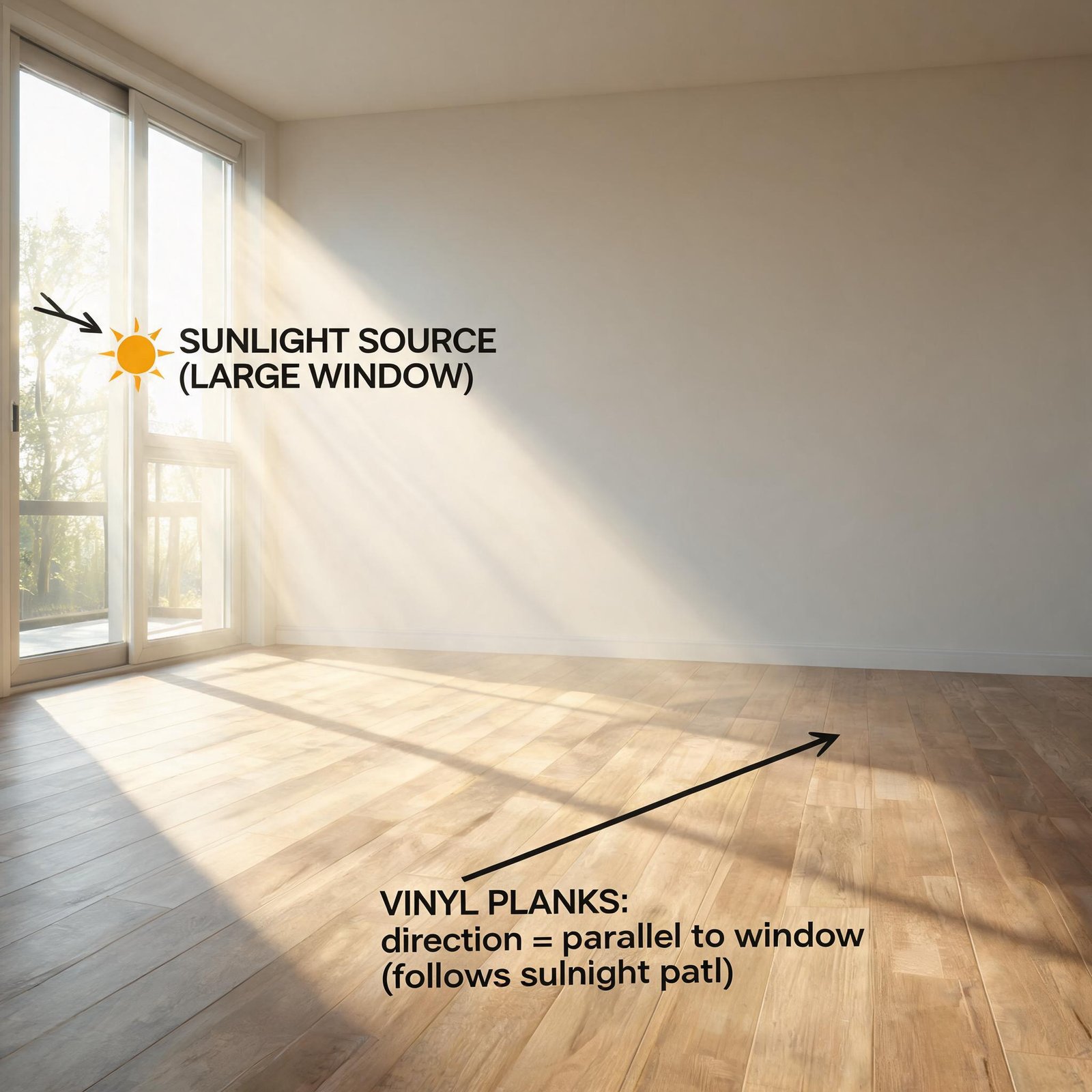
Here’s the question that frustrates even experienced renovators: do you run vinyl plank flooring perpendicular to windows? The short answer is that light source and window positioning deserve as much weight as wall length. In fact, in rooms dominated by large windows, sliding glass doors, or skylights, the flooring orientation vs. light source relationship often overrules the “longest wall” rule.
The reason is simple: side lighting from windows exaggerates seams and plank joints. When planks run perpendicular to a window wall, the light washes across the joints, highlighting each seam like a tiny shadow line. For heavily textured floors or wide-plank designs, this can create a beautiful, intentional rustic effect. But on a smooth, minimal luxury vinyl plank, it may make the floor look busier than you’d like.
Conversely, running vinyl plank flooring parallel to the primary window wall—so the length of the boards points away from the glass—lets light travel along the grain or pattern rather than across it. Shadows at the seams become far less pronounced, which yields a cleaner, more seamless appearance. That’s especially valuable in contemporary homes where the look is sleek and uninterrupted. If you have high-performance glazing that pours in consistent natural light throughout the day, it becomes even more important to test how the reflection plays off the floor’s surface. Many of our customers visit showrooms at different times of day for exactly this reason. Some opt to upgrade old window systems before installation to get the best daylight quality, knowing that modern, well-sealed frames reduce glare and protect flooring from UV fade. For instance, exploring energy-efficient uPVC windows with advanced light diffusion can make a noticeable difference in how your flooring looks from dawn to dusk.
So when is perpendicular-to-windows the right call? If a room is much longer than it is wide and the windows sit on one of the shorter walls, perpendicular planks—running parallel to the window wall—will widen the space and let side light gently skim across the joints, giving texture without chaos. But if the windows are on a long wall and the room already feels wide, parallel orientation toward the light often preserves a serene, expansive feel.
Another tip: consider how vinyl flooring and window alignment interact with furniture layout. In a bedroom where the bed faces a large window, planks running parallel to the window wall and perpendicular to the bed can ground the furniture and make the room feel more intimate. Always mock up a few rows before committing; we’ve seen a five-minute dry fit save days of regret.
Room-by-Room Direction Recommendations
Open-Concept Living Areas
In a combined kitchen, dining, and living space, continuity is king. Choose one primary direction throughout, even if it means one zone doesn’t get its “ideal” orientation. Typically, running planks parallel to the longest sightline—often from the front door to the backyard slider—keeps the flow. If windows dominate one side, weigh whether the visual calm of parallel-to-light outweighs the structural desire to go perpendicular to joists. In most modern homes with engineered subfloor systems, you have the freedom to choose aesthetics first.
Hallways
Short and wide hallways vanish with perpendicular flooring. Long, narrow corridors do better with parallel planks unless you intentionally want to break up the visual sprint. Never run boards across a hallway in a way that creates a stripey, ladder-like look unless it’s a deliberate design statement.
Bedrooms
Here, the bed is the focal point. Many designers prefer planks running perpendicular to the bed, so the lines lead the eye outward to the sides, making the room feel more spacious. If a large window faces the bed, running parallel to that window prevents direct light from spotlighting seams when the sun is low.
Kitchens
In galley kitchens, perpendicular to the length expands the width. In L-shaped or U-shaped kitchens that open to a living area, treat direction as part of the larger open plan. Always account for cabinet kick lighting—under-cabinet LEDs can cast shadows along plank joints, so test your direction with the lights on.
Bathrooms
Small bathrooms are forgiving, but moisture is the real enemy. For vinyl plank, direction matters less than ensuring the floor is fully waterproof and seams are tight. Still, running planks toward the window or light source makes a tiny room feel larger.
Flooring Material-Specific Orientation Tips
Not all floors behave the same way. A direction that works for hardwood may look entirely different in luxury vinyl plank or laminate.
Hardwood and Engineered Wood: Solid wood must run perpendicular to floor joists unless a sturdy subfloor and specific underlayment allow otherwise. Wide-plank engineered wood expands and contracts more across its width, so a parallel-to-length-grain orientation across the room can lead to gapping if humidity swings. Check manufacturer specs; never assume.
Luxury Vinyl Plank: This is the most flexible. Rigid core SPC vinyl plank can be laid in any direction without structural penalty, which frees you to prioritize optical and window alignment. The key is to consider the plank’s registered emboss—some embossed wood patterns look chunkier when light skims across them perpendicular to the grain, so align the grain with the light for a cleaner look, or against it for texture. With vinyl flooring and window alignment top of mind, our team often suggests a quick test board to see how the floor reads in morning and afternoon light.
Laminate: Laminate behaves similarly to vinyl plank directionally, but floating floors require careful attention to transitions. In large spans, running laminate perpendicular to the longest dimension can reduce stress on locking systems if temperature changes are significant, but again, the visual trumps unless structural limits kick in.
Installation Constraints: Joists, Subfloors, and Transitions
Even with today’s advanced subfloor panels, joist direction still matters for certain hardwoods. If you’re installing solid ¾-inch hardwood over an older home with joists running perpendicular to your desired plank direction, you have two choices: either accept the joist direction or add a layer of ½-inch plywood underlayment to uncouple the boards from the joists. This is a job for a qualified installer, and it may affect door clearances.
For floating vinyl plank, the subfloor must be flat, but direction is unrestricted. However, watch out for floor registers and transition strips between rooms. Changing direction between adjoining rooms without a proper transition opens the door to chipping, tripping hazards, and an unsatisfying visual break. If you must switch direction—say, a hallway perpendicular to a bedroom—use a T-molding or a flush stair nose to separate the fields cleanly.
Visualizing Your Space: Tools and Tricks
We never let a floor go in without some form of visualization. Our own room visualizer tool lets you upload a photo and see different flooring directions, but even a low-tech approach works. Lay a dozen loose planks in both orientations, then step back. Open and close window coverings, turn on interior lights, and walk the natural traffic path. Take photos on your phone; the small screen often reveals alignment flaws your eye misses in person.
One thing many neglect is testing how the floor meets large glass areas. A room flooded with natural light can change the perceived colour of vinyl plank by a whole shade. This is another reason we encourage homeowners to consider how their windows perform. Upgrading to double or triple glazing—like the options available through premium vinyl window systems that reduce UV exposure—protects both your furniture and floor, and it makes the lighting more consistent across seasons, which simplifies your flooring direction choice dramatically.
Pros and Cons at a Glance
Perpendicular Flooring
- Pros: Widens narrow rooms, highlights a focal feature, increases subfloor stiffness when crossing joists, adds texture under side light.
- Cons: Often means more cuts and waste, can make small square rooms feel chopped, emphasizes plank seams under strong side light from windows.
Parallel Flooring
- Pros: Elongates space, creates smooth flow through open areas, reduces waste, hides seams in the direction of light, suits standard joist layouts.
- Cons: Can exaggerate a tunnel effect in long, narrow rooms, may feel static in rooms without a strong sightline.
Trust Your Eye, But Follow the Rules
As a manufacturer, I believe in guidelines, not absolutes. The best direction for your floor is the one that makes you love walking into the room every day. But arriving at that answer means weighing the shape of the space, the way natural light interacts with the planks, the technical requirements of your chosen material, and how all those factors work together. Start with the longest wall, challenge it with your room’s dimensions, test it against your windows, and only then commit.
The single most important action you can take is a dry run—nothing replaces seeing the real product in your own home, at your own time of day, with your own lighting. And if you still feel stuck, lean on a professional installer or manufacturer’s design support. That’s what we’re here for.
Frequently Asked Questions
Should vinyl plank flooring always run parallel to the longest wall?
Not necessarily. While that’s a reliable starting point, light sources, room shape, and furniture layout often override it. In a room with large windows on the longer wall, parallel orientation can make seams nearly invisible, so it’s often the best choice. But if the room is extremely narrow and you want it to feel wider, perpendicular to the long wall might be better.
Does flooring direction affect resale value?
A thoughtfully chosen direction that enhances the flow and feel of a home certainly adds to market appeal. Buyers notice when a floor looks “right.” Conversely, a direction that accentuates awkward proportions or creates erratic seam lines can subtly detract, even if the material itself is high-end.
Can I change the direction of vinyl plank between rooms?
Yes, but it requires a transition strip. Without one, the flooring may separate or chip at the direction change. If the two rooms are visually connected, keeping the same direction throughout creates a more expansive, high-end look. If they’re fully separated by a door, a switch can define zones effectively.
Do you run vinyl plank flooring perpendicular to windows?
You certainly can, and in some spaces it’s ideal. When windows are on a shorter wall of a long, narrow room, perpendicular planks—running parallel to that window wall—will visually widen the room while letting side light skim across the joints for a soft, textured appearance. However, if large windows dominate a long wall, many experts prefer parallel planks that follow the light, which minimises seam visibility and yields a calmer, more contemporary finish. The final call depends on your room’s shape and the specific look you want to achieve.