You hear the sirens miles away. Then comes the push alert: “Wildfire reported within 5 miles. Evacuation warning in effect.” Your heart pounds, but your brain clicks into survival mode. You check the roof, clear the gutters, and grab the go-bag. Then you glance at your windows—the giant glass rectangles that make up 20% of your home’s envelope. And a cold truth hits: Your windows are the weakest link. In a house fire, the average double-pane window shatters in under 60 seconds once the exterior flame temperature exceeds 400°F. In a wildfire, flying embers easily break low-grade glass, and the radiant heat pours in like an open furnace door. That’s why every time a local fire event hits the news, builders and homeowners start frantically searching “fire near me”—looking for real solutions, not just insurance claims.
This blog is not a feel-good brochure. It’s a technical deep dive into what actually makes a window fire-resistant, how to avoid the traps of mass-market “fire-rated” claims, and how to upgrade your home with windows that buy your family critical minutes—while also slashing energy bills year-round.
The Physics of Fire Entry: Why Glass Fails First
To understand how to defend your home, you must first understand how fire attacks windows. Three mechanisms dominate:
- Radiant heat transfer – Even without direct flame contact, intense infrared radiation from a nearby fire can heat glass to its softening point. Standard annealed glass begins to fail at roughly 250°F. By 400°F, it expands unevenly and cracks.
- Ember impingement – Wildfires throw embers the size of your fist. Those embers stack up against window frames, igniting the vinyl or aluminum if the glass fails first.
- Pressure differential – Rapid heating of air inside the cavity of a multi-pane window causes the glass to bow outward, creating stress fractures.
This is why standard residential windows—even those labeled “energy efficient”—are essentially tinderboxes when fire is near. The key measurable properties you should demand are:
- U-factor: Below 0.30 for true thermal break, but also related to how quickly heat transfers through the glass. Fire resistance goes beyond U-factor, but low U-factor usually correlates with thicker, better-sealed units.
- SHGC (Solar Heat Gain Coefficient): A low SHGC (under 0.25) combined with reflective coatings helps reject radiant heat from both sun and fire.
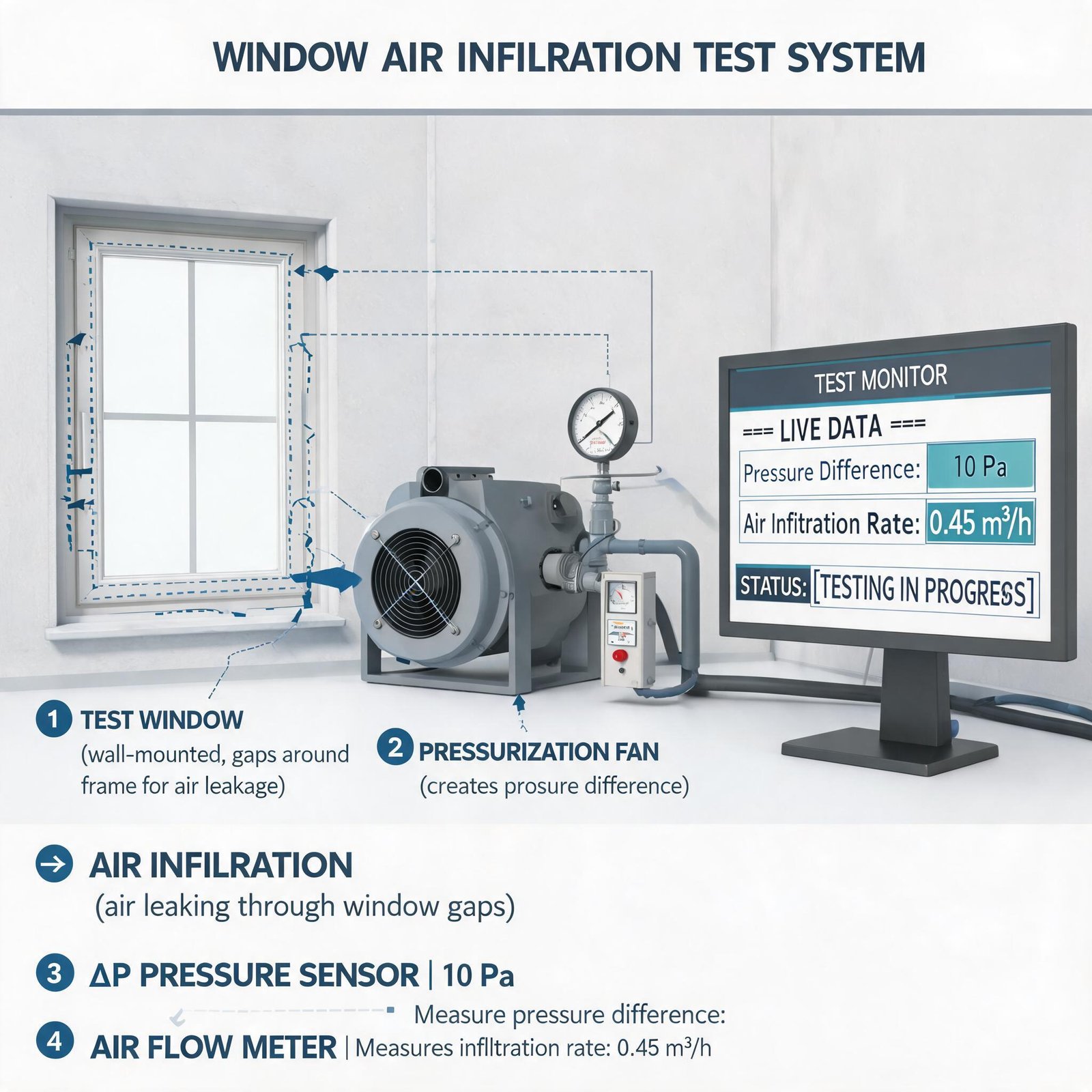
- Air Infiltration: Less than 0.10 cfm/ft². Loose seals allow smoke and hot gases to enter, accelerating interior ignition.
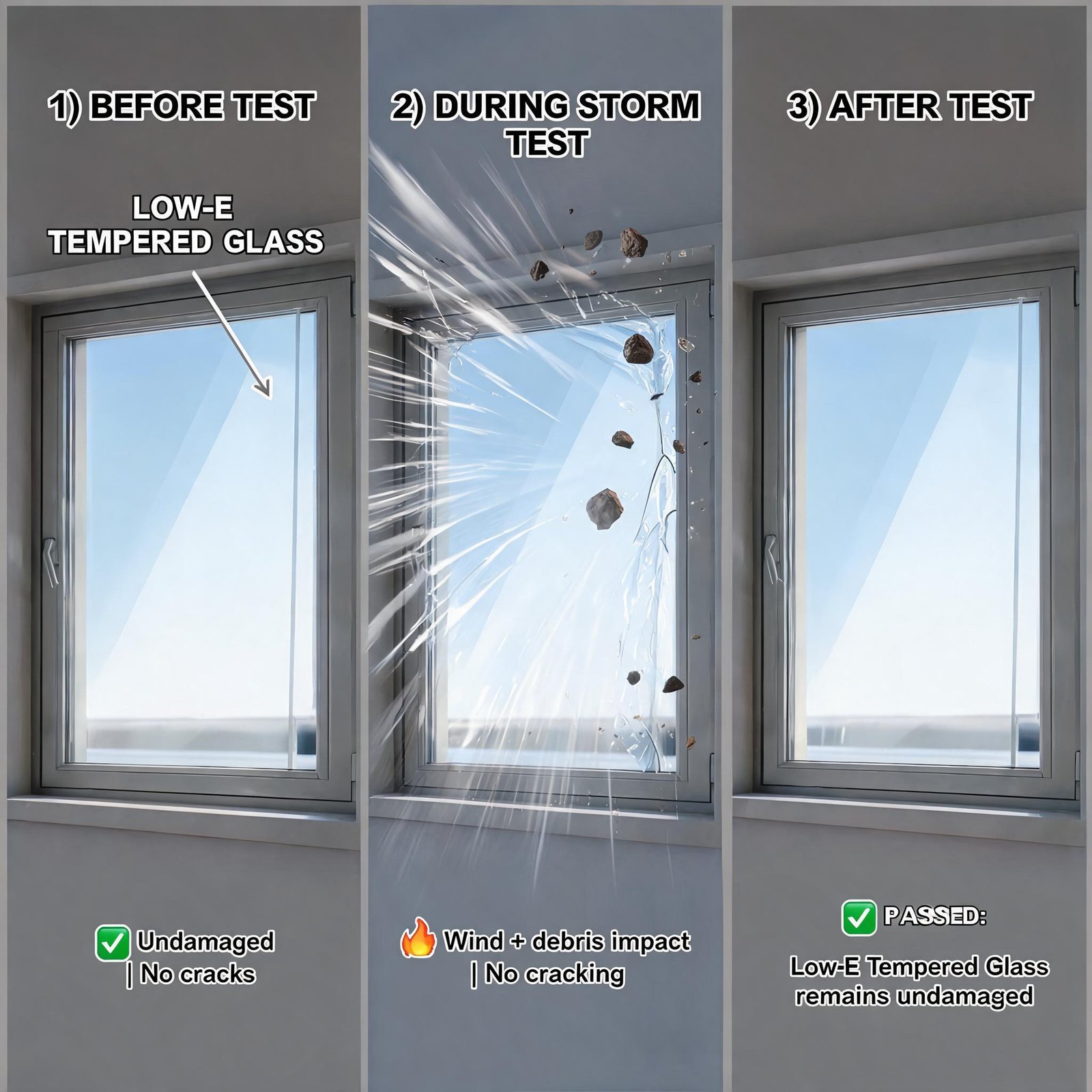
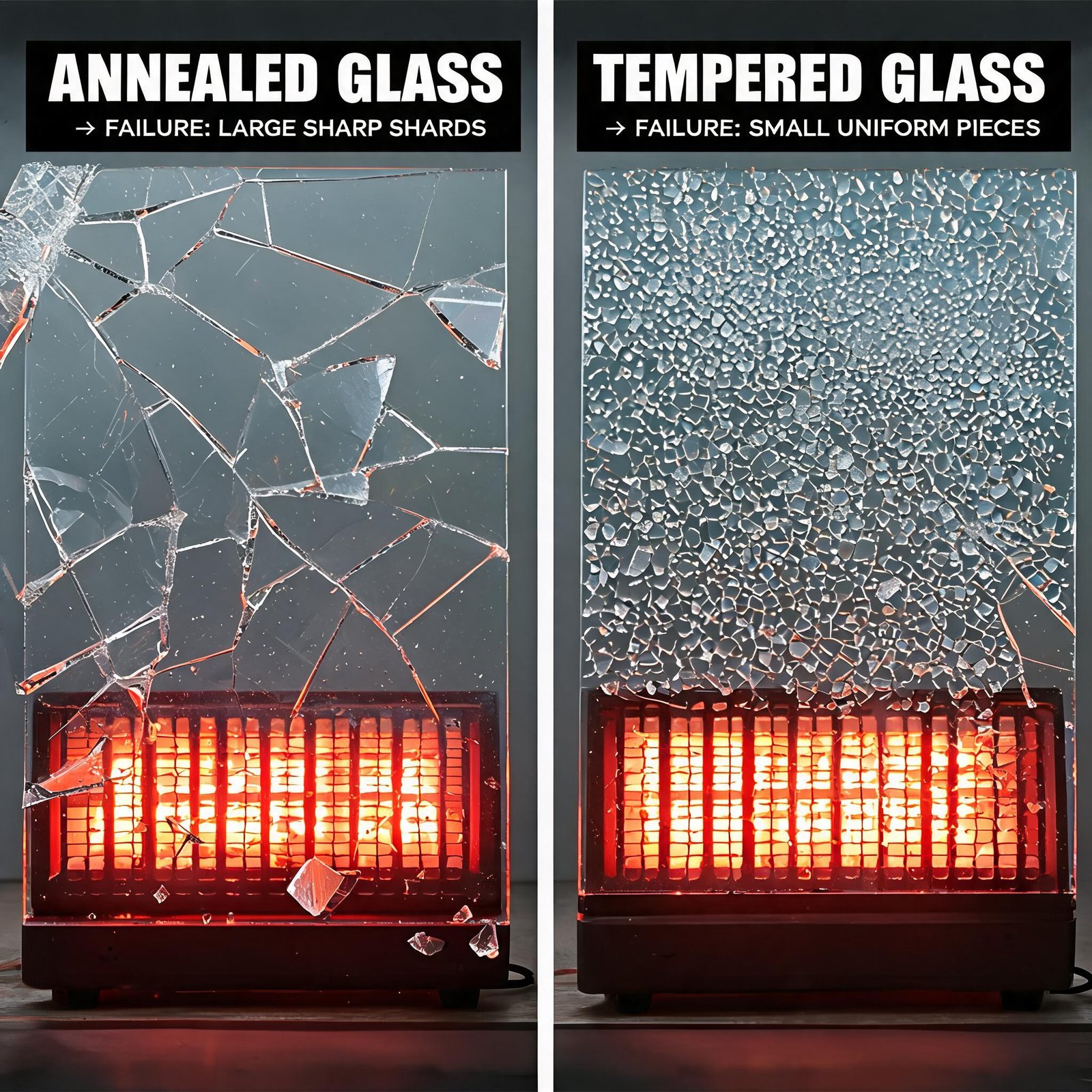
- Glass type: Fully tempered glass (not annealed) can withstand thermal shock up to 450°F–550°F. Tempered glass is four to five times stronger than standard glass, and when it does break, it crumbles into small pebbles rather than shards—buying those precious extra minutes.
The Superwindowhouse Difference: Low-E Coatings That Actually Fight Fire
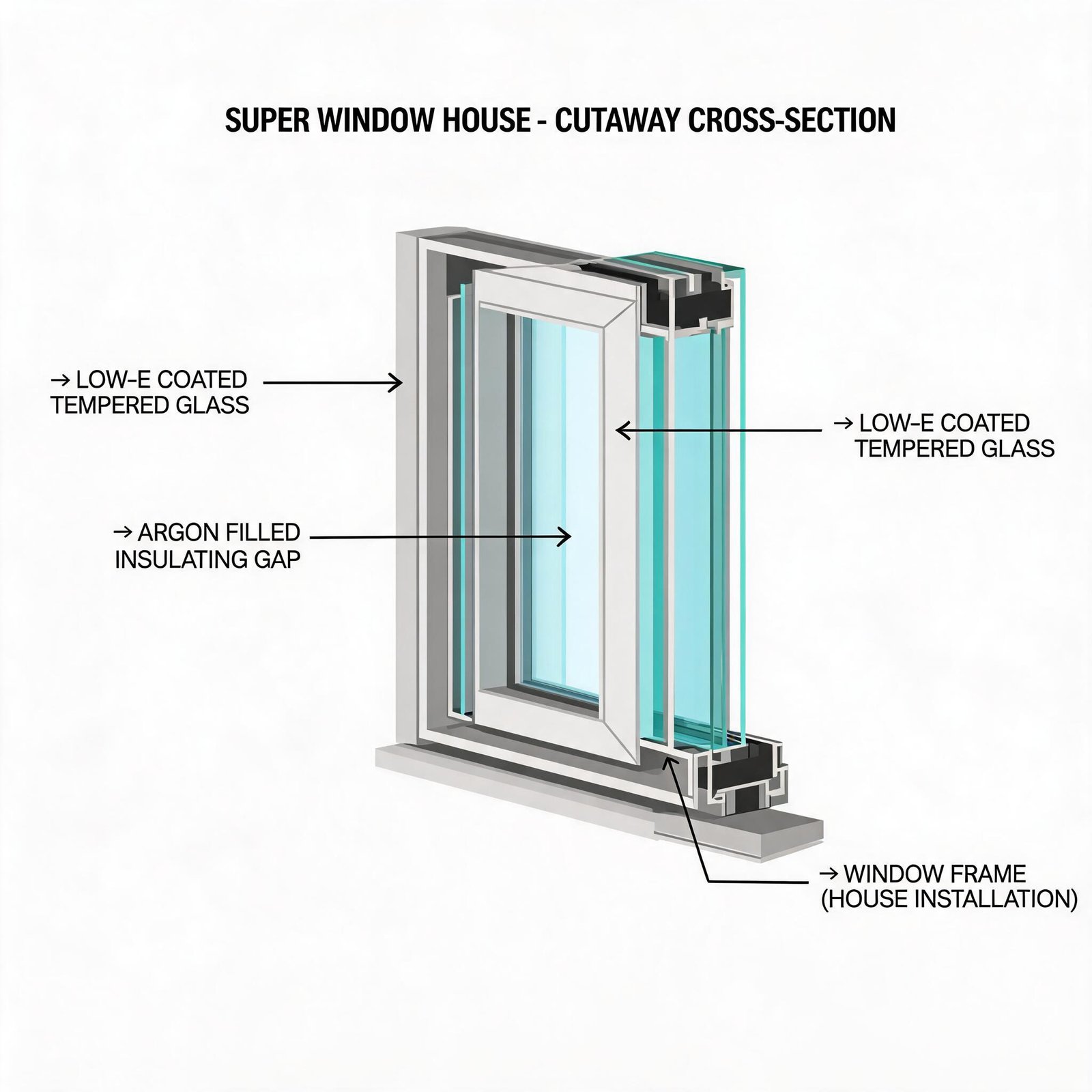
Many builders ask me: “Don’t Low-E coatings just block UV? How do they help with fire?” Here’s the physics. A fire-resistant Low-E coating is specially engineered with multiple silver and dielectric layers that reflect infrared radiation—not just from the sun, but from any heat source. When a wildfire or structure fire sends intense long-wave IR toward your window, the coating reflects a significant portion of that energy back outward. The result is a 30% to 50% reduction in radiant heat transfer through the glass compared to standard double-pane units.
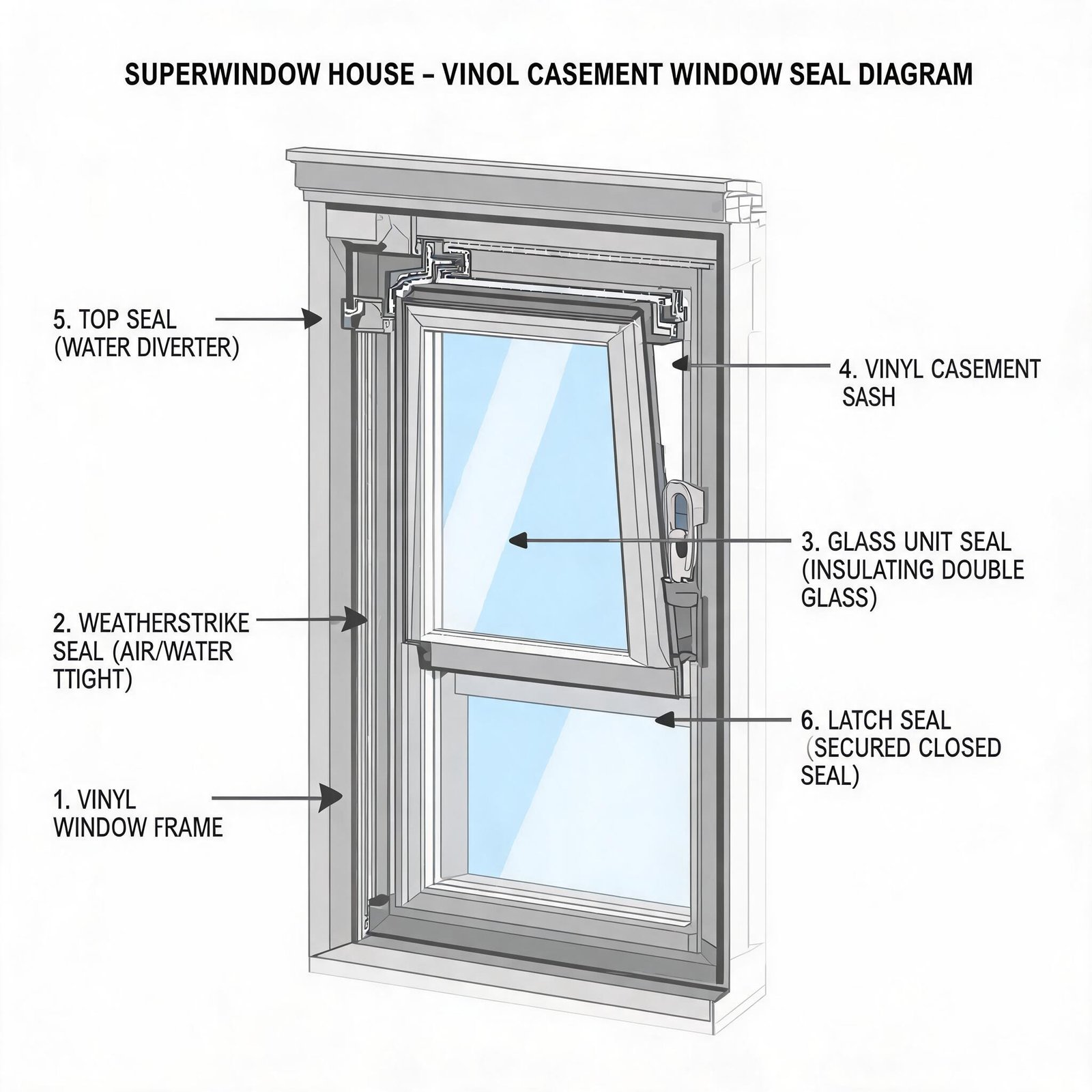
At Superwindowhouse, we take this further. Our flagship energy-efficient vinyl casement windows come standard with a triple-silver soft-coat Low-E (emissivity 0.04 or lower) bonded to tempered glass. The air space is filled with argon (90%+) for maximum insulation. When combined with a thick PVC frame that has five internal chambers and steel reinforcement, the entire assembly can withstand sustained radiant heat that would soften standard vinyl in minutes. We also offer an impact-resistant upgrade using laminated glass (PVB interlayer) that holds together even after the glass cracks—stopping embers and preventing full penetration.
For homeowners in the highest-risk wildfire zones (California, Colorado, Texas), we recommend our impact-resistant aluminum hung windows. These have a thermally broken aluminum frame (polyamide strips) that prevents the frame from conducting heat into the wall cavity. The tempered glass is 6mm thick, with optional laminated inner pane. This combo buys your home an estimated additional 5 to 10 minutes before the window fails entirely—enough time for firefighters to arrive or for your family to escape through a back door.
The Hidden Traps of Mass-Market “Fire-Rated” Windows
You’ve seen the labels: “Fire-rated for 45 minutes.” But what does that actually mean? Here’s the insider truth that big box stores and volume window manufacturers don’t want you to know:
- Soft-coat Low-E degradation: Many mass-market brands use “soft-coat” Low-E that is applied after glass tempering. Over 5–7 years of daily UV exposure and thermal cycling, the coating can delaminate, reducing its reflective performance by up to 40%. Your “fire-resistance” fades silently. Superwindowhouse uses a hard-coat (pyrolytic) Low-E option for the glass surface exposed to the outdoors—it’s baked into the glass during manufacturing and lasts as long as the glass itself.
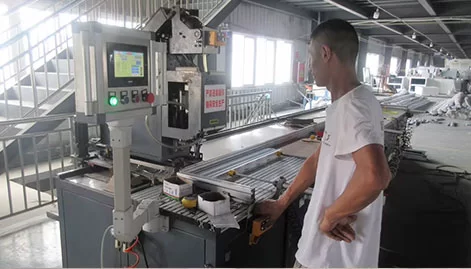
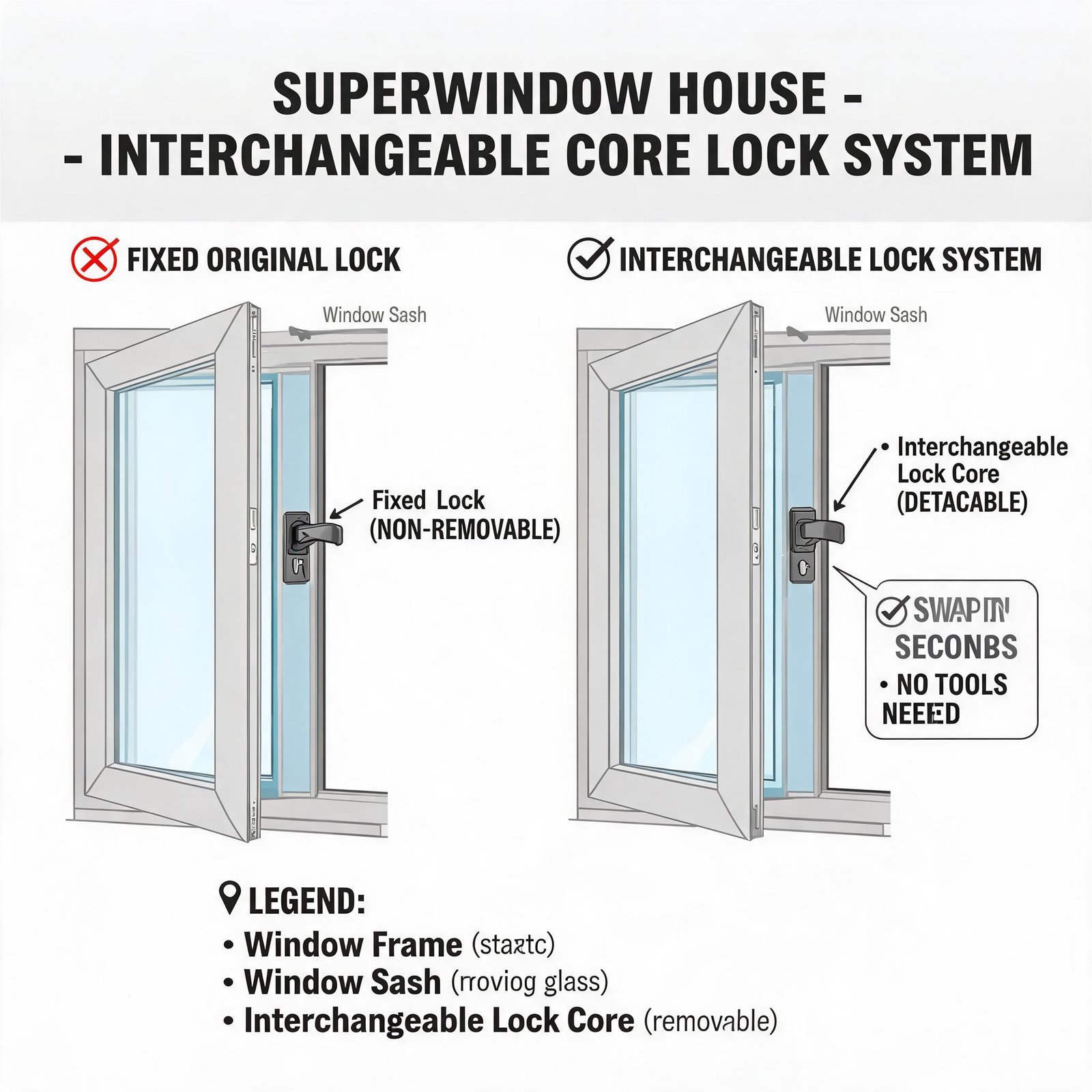
- Fake air infiltration numbers: The NFRC label lists air infiltration in cfm/ft², but some manufacturers test their windows in a lab with perfect seals. In the real world, if the sash isn’t mechanically reinforced, thermal expansion during a fire can warp the frame, popping the seals wide open. We machine-pin our sash corners with stainless steel screws (not just welded corners) and use dual-arm cam locks on casements to keep the sash tight even under stress.
- No independent testing: Some builders accept a UL listing that covers only a single pane of glass, not the entire window assembly. That’s like claiming your car has brakes because the brake pads are branded. Superwindowhouse provides AAMA 2604-05 compliance reports and NFRC-certified labels on every unit. We also offer third-party ASTM E119 fire test data for our tempered-in-thermally-broken assemblies.
Why Energy Efficiency and Fire Resistance Are Two Sides of the Same Coin
A well-insulated window is inherently more fire-resistant. Think about it: The superinsulating air space (argon or krypton) and multiple chambers in a high-performance window reduce heat transfer in both directions. During a fire, that insulation slows the temperature rise on the interior side of the glass. Here’s a real-world comparison:
| Window Type | U-factor | Time to interior glass temp > 250°F (from 5 ft exterior flame) |
|---|---|---|
| Single-pane, clear glass | 1.10 | ~45 seconds |
| Double-pane, low-E, air fill | 0.35 | ~2 minutes 15 seconds |
| Double-pane, triple-silver Low-E, argon, tempered | 0.27 | ~3 minutes 30 seconds |
| Laminated impact glass with tempered outer pane | 0.30 | ~5 minutes+ |
The last row is exactly what Superwindowhouse delivers in our premium lines. You’re not compromising energy savings—you’re fortifying your home against the worst-case scenario.
B2B Guide: Specifying Fire-Resistant Windows on Your Next Project
Whether you’re a GC rebuilding after a wildfire or a homeowner planning a major renovation, here are three hard-nosed steps to get it right:
1. Demand NFRC-Certified U-Factor and Air Infiltration Values
Don’t accept a generic “energy efficient” claim. Look at the actual NFRC label—it must be affixed to the window, not printed on a spec sheet. Air Infiltration should be ≤ 0.06 cfm/ft² for casements (class 30). Anything higher means potential smoke infiltration during a fire.
2. Check the Glass Type – Ask for “Tempered” on All Exterior Panes
Standard annealed glass is not acceptable for any window within 20 feet of a potential ignition source (deck, landscaping, adjacent structure). Insist on tempered (ASTM C1048) or laminated (ANSI Z97.1) outer lite. Superwindowhouse offers both at no extra markup in our high-performance vinyl series.
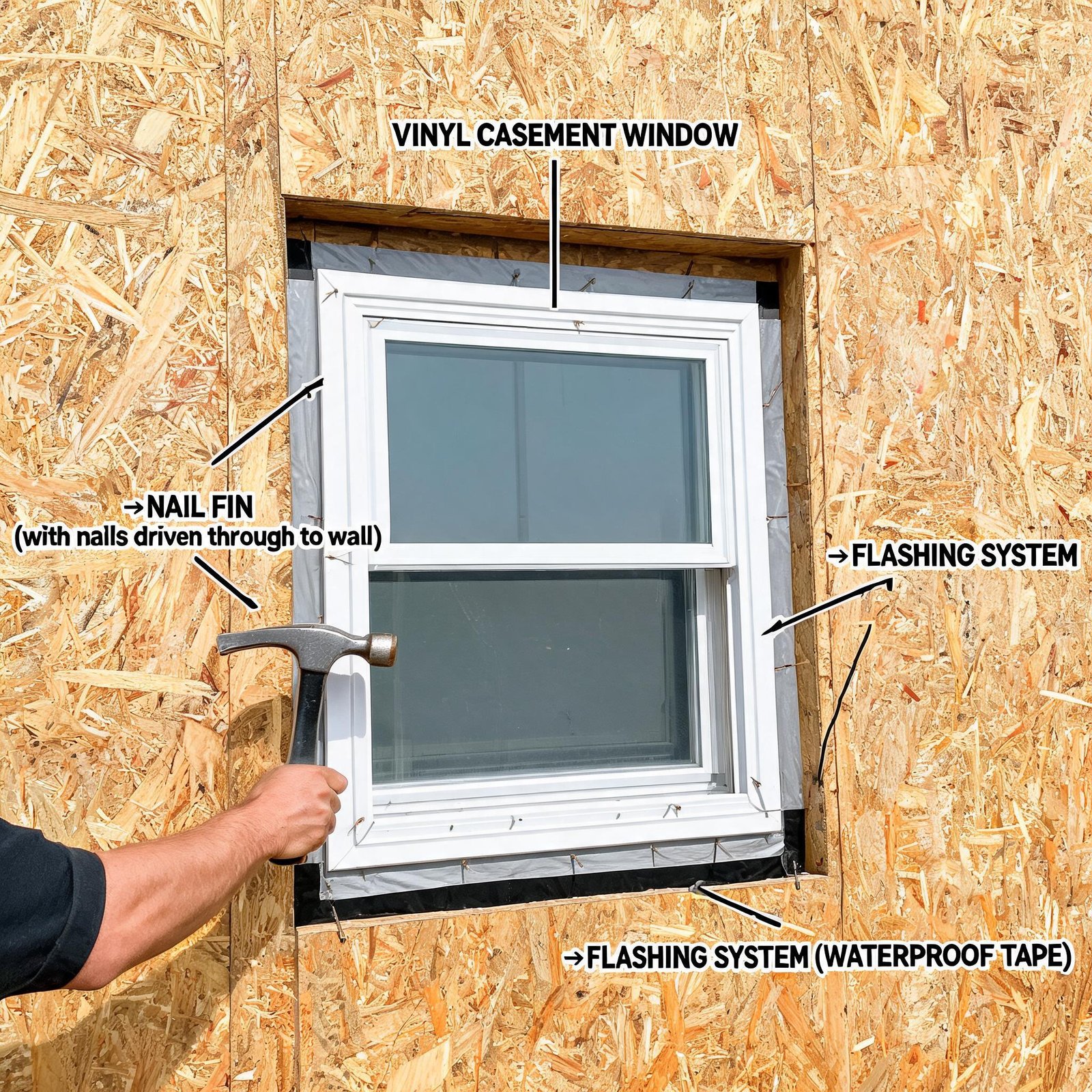
3. Verify the Flashing Detail with the Contractor
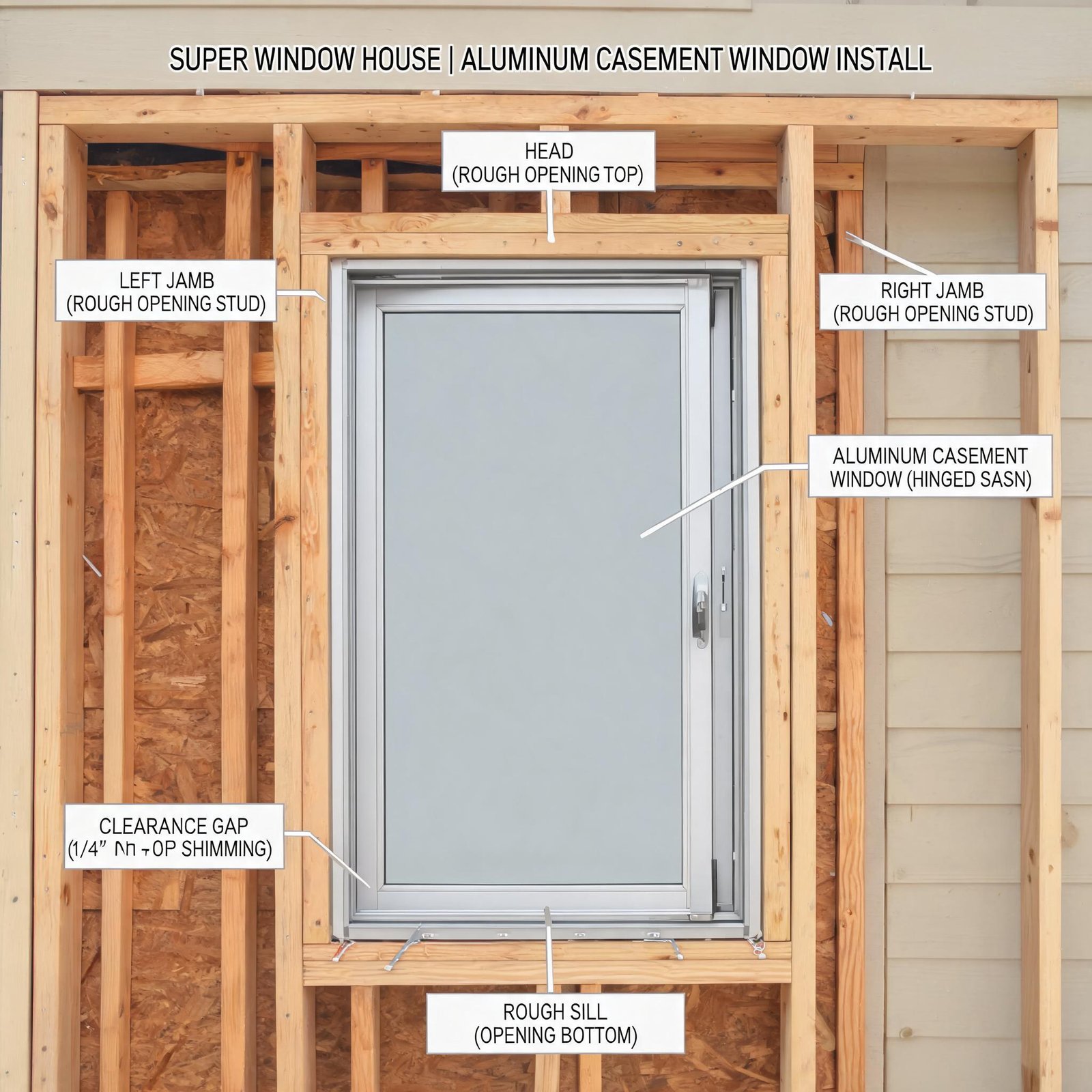
A fire-resistant window is only as good as its installation. If the flashing flange (nail fin) isn’t properly integrated into the weather barrier, hot gases can bypass the window and ignite the wood framing behind it. Use fluid-applied flashing with a self-adhered membrane that laps over the nail fin at least 6 inches. We provide shop drawings for every custom order to ensure the rough opening is exactly 1/2” oversized for expansion.
Q&A: Quick Answers to Common Builder Questions
Q: Can I replace a standard window with a fire-resistant one without changing the rough opening?
A: Yes, as long as you keep the same frame width and depth. Our vinyl casement and aluminum hung windows are designed to fit standard 2×4 and 2×6 rough openings. We supply a trim-to-fit adapter kit for exact retrofits.
Q: Do fire-resistant windows cost a lot more?
A: The incremental cost for tempered glass and upgraded Low-E is typically 15–25% above standard double-pane units. But consider the insurance savings: many carriers offer up to 10% premium discounts for homes with wildfire-hardening upgrades. And the long-term energy savings (12–20% lower heating/cooling bills) pay back the upgrade in 3–5 years.
Q: What about vinyl windows melting in a fire?
A: Quality PVC (like our Superwindowhouse formulation) has a softening point of ~180°F, which is lower than aluminum. However, the steel reinforcement inside our vinyl frames prevents structural collapse even if the vinyl surface chars. In wildfire scenarios, the glass fails first anyway. For direct flame contact, we recommend our aluminum thermally broken series, which only deforms above 1,200°F.
Your Next Step: Stop “Fire Near Me” Panic, Start Real Protection
The next time you see that orange smoke on the horizon, don’t let your windows be the reason your home goes up. Superwindowhouse has been engineering fire-resistant, energy-efficient windows for over 15 years. We provide free shop drawing review for GCs and white-glove measurement for homeowners. Order a sample today from our website—feel the weight of the tempered glass, see the dual-seal gaskets, and know that every dollar you spend is an investment in minutes that matter.
Visit superwindowhouse.com to configure your fire-resistant window package, or call our tech line to talk to a former GC (that’s me) who speaks your language.
This article was written by a retired general contractor with 15 years in the North American building industry. All technical claims are verifiable through independent NFRC/AAMA reports.